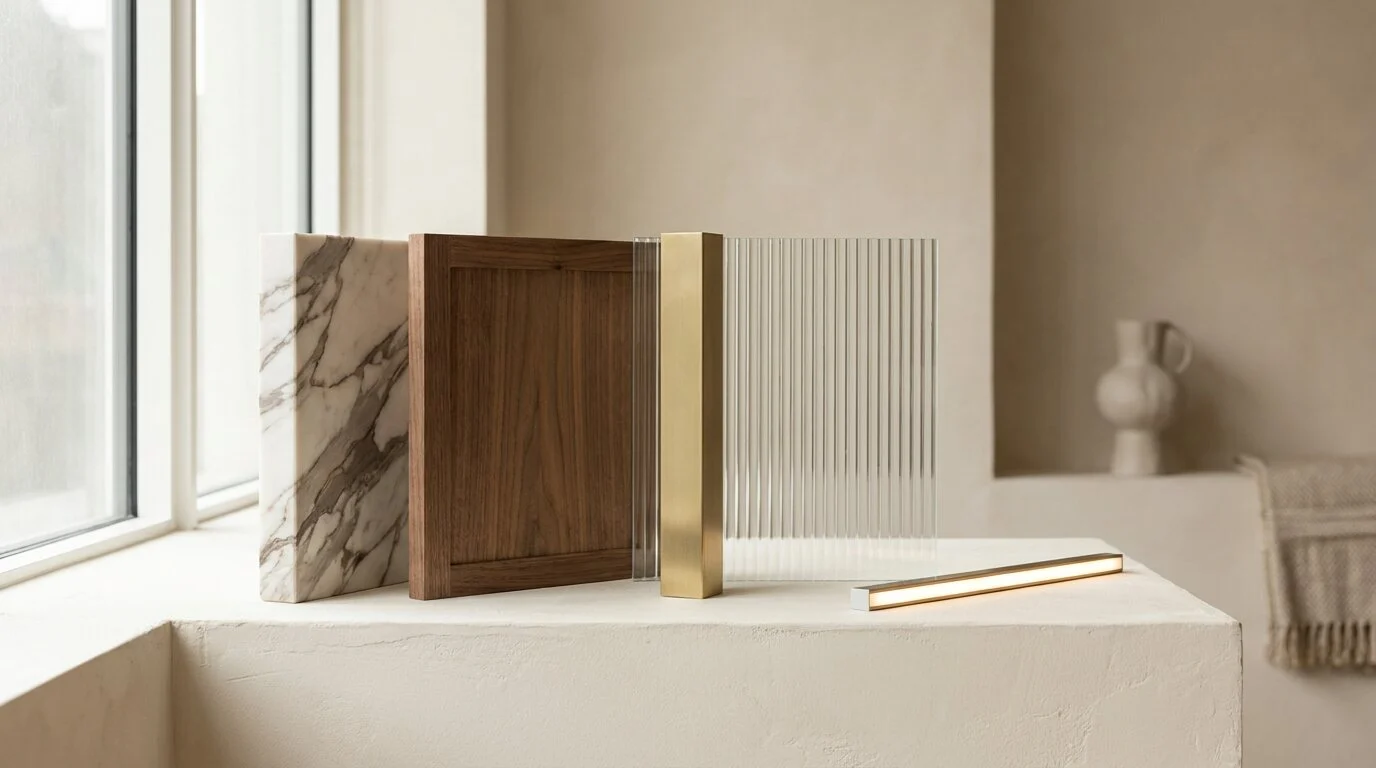
Most conversations about interior budgets in Dubai start with the wrong question. Clients ask what a villa renovation costs per square foot, and designers quote a range, and both numbers are fiction until one thing is settled: the material package. On the labour side, a competent contractor in Dubai is pricing fairly similar hours whether your project is comfortable or luxurious. What separates a modest fit-out from an expensive one is a short list of decisions about stone, joinery, metal, glass and lighting. Get those five right and the budget holds. Get them wrong and no amount of value engineering saves the project later.
Stone and marble: where the real money hides
Natural stone is the single most common place a Dubai budget breaks, and it breaks quietly. A calacatta or statuario marble at AED 900 to 1,400 per square metre looks almost identical, on a screen, to a porcelain interpretation at AED 180 to 320. The difference compounds because stone is priced per square metre but consumed in slabs, and slab yield is where projects lose money that never appears on any quote. A 3-metre kitchen island with bookmatched waterfall edges can consume four slabs to use two, and the offcuts belong to you, not the fabricator.
The decisions that actually control stone cost are sequence decisions. Decide the vein direction and bookmatch layout before anything is ordered, not when the fabricator calls from the warehouse. Approve the actual slabs, tagged with your project name, in person or by video. And reserve the expensive marble for the surfaces the eye lands on first: the entry feature wall, the island top. Run the perimeter counters, the utility areas and the bathrooms in a complementary porcelain. Nobody has ever walked into a laundry room and admired the marble.
Joinery: the budget line that doubles when nobody is watching
Bespoke joinery is the second killer, because it is quoted in running metres but detailed per panel. Fluted wall panelling, integrated handleless kitchens, wardrobes with concealed doors and veneered ceilings all sit on the same skeleton, yet each multiplies the shop-drawing and finishing hours. A flat sprayed MDF panel is one coat of preparation. A fluted oak panel is sixteen routed grooves per board, each one sanding and finishing time, and each groove a place where a rushed workshop shows.
The practical approach is to decide, at concept stage, which rooms get bespoke joinery and which get semi-bespoke or imported units. A master dressing room earns bespoke because proportions there are specific to the room and to you. A children’s wardrobe wall can be beautifully resolved with a good imported system behind a bespoke fascia, at roughly forty percent of the cost. The seam is invisible when the fascia, handles and colour are matched by the same workshop.
Metal finishes: small numbers, big multipliers
Brushed brass, blackened steel and PVD-coated profiles are cheap per unit and punishing in aggregate. A single brushed brass door handle might be AED 400. A villa has between forty and eighty internal doors, and every one of them wants the same handle, plus hinges, plus locks, plus the matching switches and sockets, plus the shower profiles and the mirror frames. Finish loyalty across a whole house is a design decision with a six-figure tail on large villas, and it is usually made casually in one mood board meeting.
Two honest ways through. Either commit to the metal properly and cut elsewhere, or restrict the premium finish to the rooms and touch points that matter, and run a good architectural satin chrome or powder-coated black elsewhere. Mixed metal is no longer a compromise; it is a legitimate scheme when the palette is deliberate. What reads as an error is one premium handle on a door framed by a cheaper architrave nobody thought to match.
Glass and mirrors: the detailing nobody prices early
Mirrored wardrobes, back-painted glass splashbacks and frameless shower enclosures all look like simple line items until tempering, polishing and installation enter the price. Every cut-out for a socket, every polished edge and every custom bend is priced separately, after the layout is final. Clients discover at installation stage that moving one socket two hundred millimetres re-tempered an entire glass panel. The fix is boring and effective: freeze the electrical and plumbing layouts before glass is ordered, and treat any change after that point as a costed variation, not a favour.
Lighting: the false economy that eats the others
The cheapest place a project goes wrong is lighting, and it is cheap in both senses. Fittings are bought late, under pressure, at retail. Layers that were drawn in the lighting plan as adjustable washes get value-engineered into fixed downlights, and the fluted panelling and bookmatched marble that consumed the budget are then lit like a corridor. It is the one economy that visibly devalues everything else you spent on.
Keep three things when the budget squeezes: dimming on every circuit you sit or entertain in, correct colour temperature consistency (2700K in living areas, 3000K in work areas, and never both in one sightline), and the track or profile positions as drawn. The fittings themselves can be mid-range. Position and control are what make a room feel designed; the fitting is just the object doing the work.
A sequence that protects the budget
Across our projects, the pattern is consistent. The material package is decided before tender documents are issued, slab by slab and panel by panel, with a written allowance schedule so the contractor prices the same assumptions the client approved. Variations are costed before they are instructed, not discovered in the final account. And the five categories above are reviewed together, monthly, because they trade against each other: money saved on metal moves to lighting, savings on porcelain buy the marble island.
If you are planning a project and want that allowance schedule reviewed before you sign a contract, that is precisely the work we do at concept and design stage, and it continues through full project management and supervision so what was drawn is what gets built. You can also see how these decisions land in real rooms in our project gallery. The earlier the material package is fixed, the fewer surprises there are, and the more of the budget ends up visible in the finished space instead of lost in variations.