
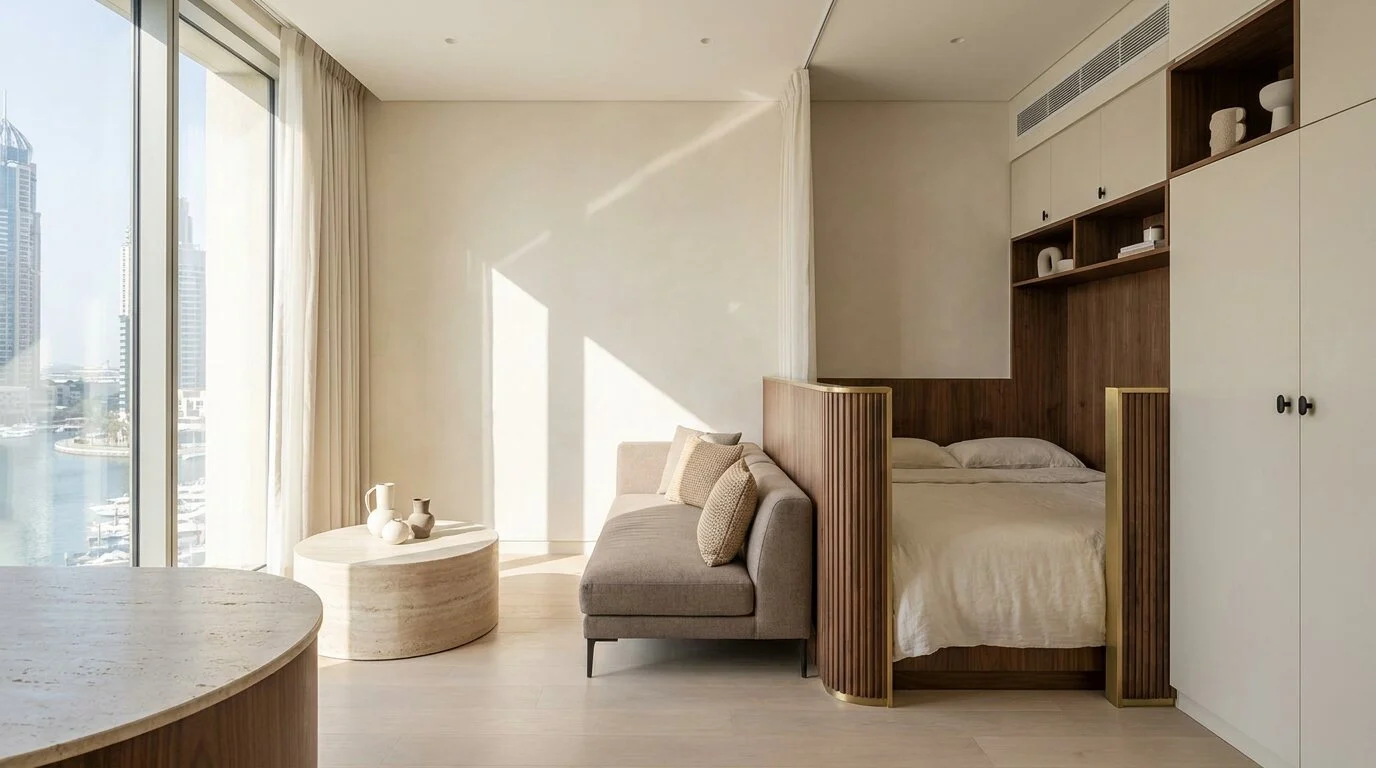
Dubai has more small-format apartments per capita than almost any city on earth, and the majority of them are furnished the same way: one oversized sofa, a bed pushed against a wall, a dining table nobody uses, and a curtain where a wall should be. The unit measures fine on the floorplan and feels cramped the day you move in. The gap between those two facts is design, not square footage.
Here is how we approach compact apartments in Dubai, with numbers that apply to the buildings most of our clients live in: Marina studios around 420 to 550 sq ft, JLT one-bedrooms around 700, Business Bay studios between 450 and 650.
Start with the plan, not the furniture
Before a single item is ordered, map the apartment to its three zones: sleep, live, and work or dine. In a 500 sq ft studio those zones need physical separation, not just rugs and intent. The two devices that consistently work:
- A ceiling-mounted track with a sliding panel between the bed and the living area. Done in a fabric that matches the walls, it reads as architecture rather than a curtain. Budget AED 3,500 to 6,000 installed.
- A 40 cm deep open shelving unit as a half-wall. It stores books and objects on both sides, lets light through, and costs a fraction of a stud partition.
What almost never works in Dubai studios: full-height partitions without a window on one side. You gain a “bedroom” and lose the daylight that made the apartment feel big, and in a unit with a single aspect window that is a permanent downgrade.
Buy for the ceiling height, not the floor area
Most Marina and Business Bay towers deliver 2.9 to 3.2 metre ceilings, and nearly everyone wastes them. Vertical storage to within 30 cm of the ceiling roughly doubles what a given footprint can hold. A floor-to-ceiling unit 2.4 metres wide and 60 cm deep, about 1.4 sq m of floor, holds more than four dressers.
The same logic applies to sightlines. Keep the lowest piece of furniture you can in the walking path: a 38 cm bench at the entry instead of an 80 cm console, a bed on a low frame rather than a storage divan. Every metre of visible floor you preserve between the door and the window is what the eye reads as space.
The three mistakes we correct most often
The oversized sofa. In a 450 sq ft studio a 3-seat sofa at 220 cm wide eats the entire living zone. A 180 cm two-seater plus one accent chair seats the same number of people, and the chair can move. Measure the sofa against the wall it will face before buying, not in the showroom.
The dining table for four. Studio residents in Dubai eat at the counter, on the sofa, or out. A 60 cm round drop-leaf table against the wall covers the occasional dinner guest and disappears the rest of the week. A four-seater dining set in a studio is furniture you walk around every day for a scenario that occurs six times a year.
Dark floors, dark walls, dark curtains. Dubai light is hard and horizontal. Matte off-white walls, a floor no darker than mid-oak, and sheer curtains under a blackout layer keep the apartment readable at noon and at midnight. Full blackout on its own makes a small unit feel like a corridor whenever it is closed, which in a studio is whenever you sleep.
Storage math that actually works
Count storage in litres, not pieces. A single person in a studio generates roughly 300 to 400 litres of seasonal rotation: summer clothes, winter clothes, luggage, sports gear. Plan for it in three places: bed frame drawers (about 300 litres on a queen), the vertical unit, and one ceiling-height cabinet in the kitchen for the things you touch twice a year. If the plan cannot show where the suitcases live, it is not finished.
Where the budget goes in a typical studio
For a full furnishing of a Marina or Business Bay studio, the split that delivers the most perceived value per dirham is roughly: 35 percent on the two anchor pieces (sofa and bed, buy these properly), 20 percent on window treatments and lighting, 20 percent on storage, 15 percent on rugs and textiles, and 10 percent held back for the second pass. The second pass matters: after six weeks of living in the space you will know exactly what is missing, and the reserve is what turns a furnished apartment into a finished one.
If you are starting from an empty unit and want the full treatment, our interior design service covers space planning, sourcing, and installation for exactly this building type. Most clients also start with a look at our project portfolio to calibrate style before committing. And if your timeline is a handover unit that needs to be rentable in three weeks, tell us that upfront, because it changes the sourcing strategy completely.
Frequently asked questions
How can I make a small studio apartment in Dubai feel bigger?
Start with the plan, not the furniture. Separate the sleep, living and work or dining zones physically, keep daylight flowing rather than building full-height partitions, and use the ceiling height for storage. Keep low furniture in the walking path, such as a 38 cm bench instead of an 80 cm console, because visible floor between the door and the window is what the eye reads as space.
What is the best way to separate the bed from the living area in a studio?
Two devices consistently work. A ceiling-mounted track with a sliding panel in a fabric matching the walls reads as architecture rather than a curtain, at AED 3,500 to 6,000 installed. A 40 cm deep open shelving unit used as a half-wall stores books and objects on both sides, lets light through and costs a fraction of a stud partition.
What size sofa and dining table suit a Dubai studio apartment?
In a 450 sq ft studio, a 3-seat sofa at 220 cm wide eats the entire living zone, while a 180 cm two-seater plus one movable accent chair seats the same number of people. Instead of a four-seater dining set, a 60 cm round drop-leaf table against the wall covers the occasional dinner guest and disappears the rest of the week.
How should I split the budget when furnishing a studio in Dubai Marina or Business Bay?
The split that delivers the most perceived value per dirham is roughly 35 percent on the sofa and bed, 20 percent on window treatments and lighting, 20 percent on storage, 15 percent on rugs and textiles, and 10 percent held back. That reserve funds a second pass after six weeks of living in the space, when you know exactly what is missing.


