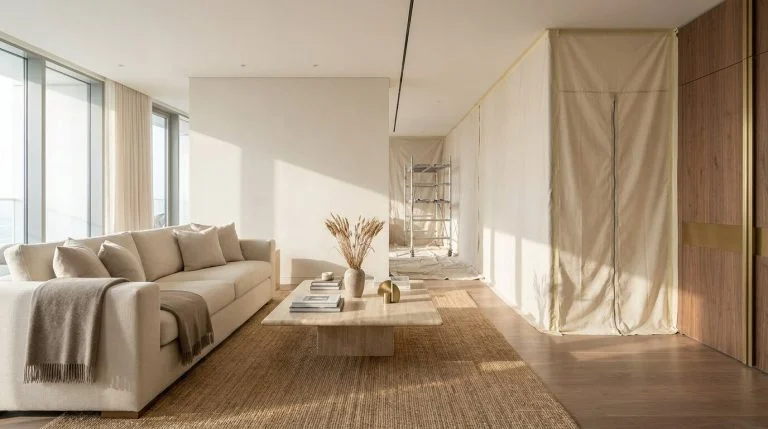
An apartment renovation checklist for Dubai should cover eight stages: the building permissions, the scope and budget, the approvals, the demolition and rough works, the MEP, the finishes, the joinery install, and the snag and handover. A standard two bedroom apartment runs AED 120,000 to 250,000 for a full renovation and takes 10 to 16 weeks on site. Most delays we see come from stages one and three, where owners start buying tiles before the building has said yes to anything.
Here is the checklist we work through on every apartment project, in the order that actually protects your budget.
1. Building and landlord permissions first
Before you spend a dirham on design, confirm what your building allows. Most Dubai towers require:
- Written no objection from the landlord or building management for any works beyond decoration
- A DEWA-coordinated disconnect and reconnect for anything touching the meter or the risers
- Contractor insurance and a permit to work, usually a deposit of AED 2,000 to 5,000 refundable after handover
If you rent rather than own, the landlord’s written consent comes first. Renovating a rented home in Dubai sits under the tenancy law, and the rules on what you may change differ from what an owner may change. Our post on sequencing work in an apartment you still live in covers the practical side of this.
2. Fix the scope before the design
Scope creep is the number one budget killer in apartment work. Decide now:
- Which rooms change and which stay untouched
- Whether the kitchen layout moves (moving plumbing costs AED 8,000 to 20,000 alone)
- What stays: appliances, sanitary ware, doors, AC units
Write the scope into one page and make every later decision trace back to it. Our guide to the decisions that rewrite a fit-out budget explains which choices carry the most money.
3. Survey and measure properly
Apartments in Dubai are measured to the developer’s handover drawings, and those drawings are often wrong by 50 to 150 mm per room. Get a measured survey before joinery is drawn. A wardrobe cut 100 mm too wide is a remake, and a remake is four to six weeks of waiting.
4. Budget with contingency, not hope
For a standard two bedroom apartment, budget:
- AED 120,000 to 250,000 for a full standard renovation
- AED 300,000 and up for premium finishes and custom joinery
- A contingency of 10 to 15 percent, not the 5 percent people hope for
Apartment-level cost bands by room are in our Dubai apartment renovation cost guide. Keep the budget line-itemed so a change in one room shows up before it eats another.
5. Approvals in parallel with design
Apartment fit-out approvals in Dubai usually route through the building’s appointed consultant. Expect:
- 10 to 25 working days for a standard fit-out permit set
- A separate Civil Defence review if you add fire alarm, sprinkler or emergency lighting changes
- Management fees of AED 1,500 to 5,000 depending on the building
Submit while the design is still flexible. Approvals come back with comments, and comments are cheaper to absorb at drawing stage than on site.
6. Demolition and rough works
Once permits are issued, the sequence matters:
- Protection of lifts and corridors, then soft strip
- Masonry changes: new openings, blocking, shafts
- First fix MEP: pipes, conduits, ducts
- Waterproofing of wet areas, with a 48 hour flood test on every bathroom
Skipped flood tests are the most expensive false economy in apartment work. Water travels down through slabs and you pay for the ceiling below as well as your own floor.
7. Finishes and joinery
Order long-lead items at permit stage, not at finishing stage. Typical apartment lead times:
- Kitchens: 8 to 12 weeks
- Wardrobes: 6 to 8 weeks
- Imported tiles and stone: 4 to 8 weeks
- Doors: 6 to 10 weeks
Tile, plaster, and paint run while the joinery is in production. Ceiling heights in most Dubai apartments sit between 2.7 and 3.1 m, so false ceiling and lighting plans should be drawn to the measured survey, not the brochure. Kitchen dimensions and clearances are in our kitchen layout dimensions post.
8. Snag, test, handover
Do not release the final payment before:
- Every socket and switch tested and labelled
- AC balancing done and supply temperatures checked
- Doors and drawers soft-close checked, hinges adjusted
- A written snag list signed by the contractor with a rectification date of two weeks or less
Retention of 5 to 10 percent held until the snag list closes is standard and reasonable. Our post on snag lists, retention and sign-off covers the handover paperwork in detail.
What usually goes wrong
The pattern repeats across projects. Owners skip the building permissions stage and lose four weeks. They order joinery before the survey and lose six weeks to a remake. They waterproof without a flood test and lose that money twice. Work the checklist top to bottom and the 10 to 16 week site programme holds. Skip stage one and no later stage saves you.
If you want a second pair of eyes on the checklist for a specific apartment, we are happy to walk through it in a consultation.